Basic Use and Menu Structure
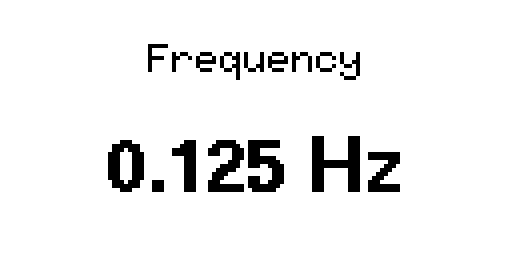
Main Page Overview
The main page provides a quick view of essential information:
Selected Mode
Frequency
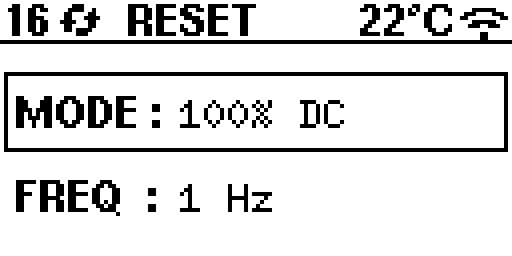
The top status area shows:
Number of satellites (GPS fix quality)
Sync status (searching vs locked)
ZT-100 ID
Wi-Fi status
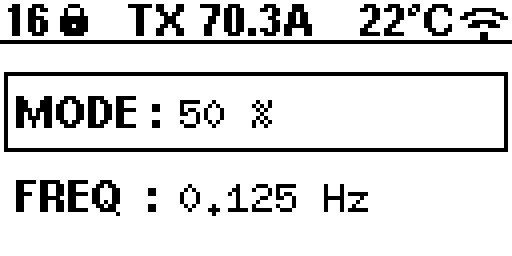
Mode Adjustment on Main Page
To switch modes on the main page:
Make sure MODE is selected (use SELECT).
Press and hold UP or DOWN for about 2 seconds.
Frequency Adjustment on Main Page
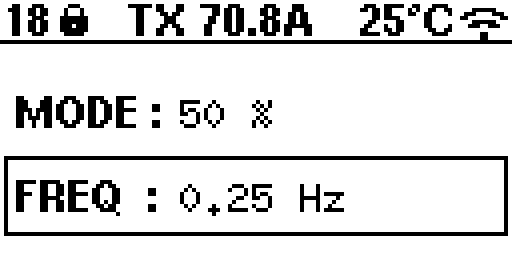
To adjust frequency on the main page:
Make sure FREQUENCY is selected (use SELECT).
Use UP/DOWN to increase or decrease the frequency.
Modes
100% DC: Full frequency range.
50%: Limited frequency range (currently 0.0078125 Hz to 32 Hz).
Custom: User-defined sequence mode (file upload via web app).
MMR 5Hz: Fixed 5 Hz mode (frequency selection hidden).
In Basic XMT mode, only 100% DC and 50% are available. In Advanced XMT mode, all four modes are available. You can switch between Basic and Advanced either from the device menu (More Info -> XMT Mode) or from the web interface More panel.
Menu Options
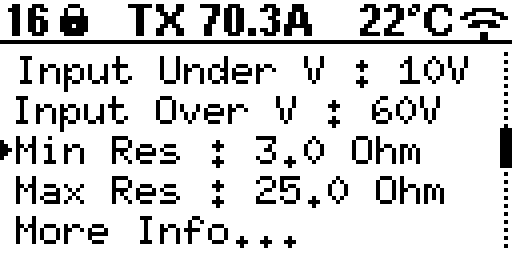
From the MENU screen you can:
Adjust Input Under Voltage and Input Over Voltage limits.
Adjust Minimum Resistance and Maximum Resistance limits.
Open More Info… for status and system tools.
Value Editor
Selecting a limit opens the value editor:
UP/DOWN (short press): Coarse steps.
UP/DOWN (long press): Fine steps.
SELECT (short press): Toggle coarse/fine mode.
SELECT (long press): Save and return.
More Info Screen
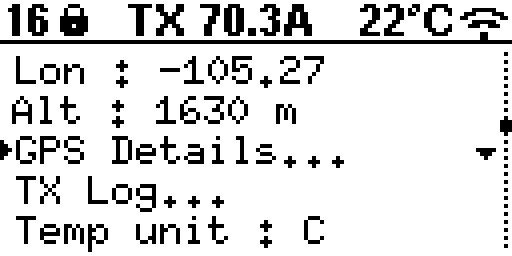
The More Info screen shows status and configuration:
XMT Mode: Toggle Basic/Advanced.
GPS Time / GPS Date
Latitude / Longitude / Altitude
GPS Details…: Opens the GPS details list.
TX Log…: Opens the transmit event log.
Temp unit: C or F.
Version: Firmware version.
ZT-100 #: Instrument ID.
Screen Light: On/Off.
Wi-Fi status: On/Off.
IP: Shown when Wi-Fi is enabled.
GPS Details Screen
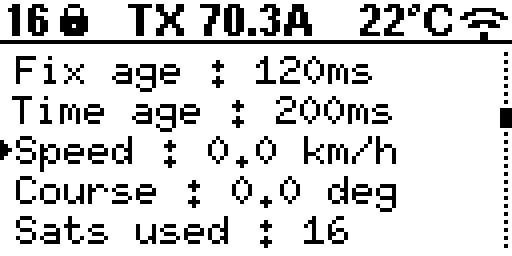
The GPS details list includes:
HDOP
Fix age and time age
Speed and course
Satellites used
GPS satellites and GLONASS satellites
PPS count
Transmit Workflow (Step-by-Step)
Press RESET to start the reset/arm sequence.
The system checks all protection and status conditions.
If no errors are reported, the screen shows RDY (arm window).
Press TRANSMIT during the arm window.
The system measures load resistance (MOR).
If the load is in range, transmit begins. If not, ORE is shown.
Press TRANSMIT or RESET to stop transmit and return to safe state.
Status Labels (Top Bar)
The top bar shows a short label for the transmit state. Common labels are:
ZT-100: Boot/initial state.
RESET: Reset sequence active or waiting in safe state.
RDY: Armed window open for transmit.
MOR: Measuring load resistance.
ORE: Load resistance out of range or timed out.
TRANSMIT: Transmit active.
STOPPED: Transmit stopped by operator.
ERR: Shared error line asserted (failsafe wait state).
R x.x: Last measured resistance shown during transmit.
TX x.xA: RMS current shown during transmit.
Error Codes
Protection codes such as SM EMER, MM OCP, and GM OTMP identify the subsystem and condition that stopped operation. Any error code disables the transmitter output and returns the controller to a safe wait state.
For the meaning of every firmware-defined code and the recommended operator response, see Error Codes and Corrective Actions.